
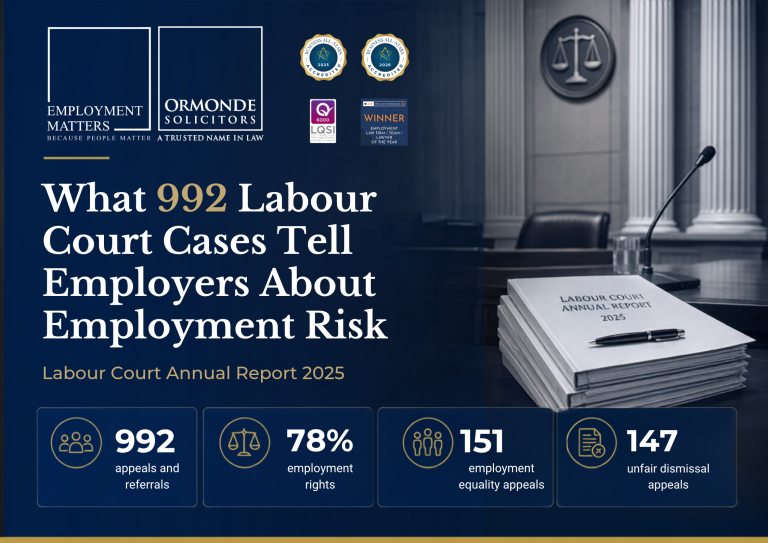
What 992 Labour Court Cases Tell Employers About Employment Risk
Employment disputes reaching the Labour Court fell during 2025, but that does not necessarily mean employment law risk is becoming easier for employers to manage.
The Labour Court's recently published Annual Report for 2025 shows that it received 992 appeals and referrals during the year.
Of those, 775 — or 78% — concerned employment rights, while the remaining 217 arose under industrial relations legislation.
Although the overall number of cases was 11% lower than in 2024, the Court highlighted the increasing complexity of the cases coming before it and the additional sitting time some appeals now require.
For employers, the numbers provide a useful indication of where employment disputes continue to arise — and where preventative HR processes matter most.
The numbers at a glance
Appeals and referrals received by the Labour Court in 2025
Related to employment rights appeals
Employment Equality appeals
Unfair Dismissal appeals
The overall number of referrals and appeals fell from 1,119 in 2024 to 992 in 2025.
Employment rights appeals also fell overall, from 885 to 775.
But fewer cases did not necessarily mean less work. The Labour Court reported that cases are becoming increasingly complex and can require more sitting days to resolve.
Dismissal and equality remain major areas of dispute
The breakdown of employment rights appeals is particularly useful for employers.
| Type of Appeal | 2025 Appeals | Trend |
|---|---|---|
| Employment Equality | 151 | One of the two largest categories |
| Unfair Dismissal | 147 | Up 9% |
| Payment of Wages | 113 | Down 29% |
| Organisation of Working Time | 90 | Down 27% |
Nearly 300 appeals related to either employment equality or unfair dismissal.
Those figures reinforce something employers regularly see in practice: the greatest legal exposure often arises not from an unusual technical breach, but from the decisions made when managing people.
Unfair dismissal appeals increased
There were 147 unfair dismissal appeals during 2025, representing an increase of approximately 9% on the previous year.
That should be particularly relevant to employers because dismissal disputes frequently turn on two separate questions:
- Was there a substantial reason for dismissal?
- Was a fair procedure followed before the decision was made?
A potentially legitimate concern about conduct, performance, attendance or capability does not automatically make the resulting dismissal fair.
Employers need both a defensible reason and a defensible process.
That means investigations, warnings, disciplinary meetings, opportunities to respond, proportionality and appeal procedures should not be viewed as administrative formalities.
Employment equality disputes remain equally significant
Employment Equality accounted for 151 appeals — slightly more than unfair dismissal.
Equality disputes can arise across every stage of the employment relationship, including:
- Recruitment;
- Pay;
- Promotion;
- Working arrangements;
- Reasonable accommodation;
- Disciplinary decisions;
- Retirement; and
- Termination of employment.
Recent decisions also demonstrate why employers must be conscious not only of overt discrimination but of potentially discriminatory assumptions entering decision-making processes.
Equality risk should be considered before a decision is implemented, rather than only after an employee raises a complaint.
A WRC decision may not be the end of the dispute
Employers should also remember that many WRC employment-rights decisions can be appealed to the Labour Court.
The Labour Court hears employment-rights appeals and issues legally binding determinations.
An appeal of an Adjudication Officer's decision must generally be submitted to the Labour Court within 42 days of the date of the decision.
Receiving a WRC decision should trigger an immediate assessment of the decision, the evidence, the commercial implications and the appeal deadline.
An appeal does not automatically mean the WRC decision will be overturned
Separate figures in the Workplace Relations Commission's 2025 Annual Report provide useful context.
The WRC reported being notified of 300 Labour Court decisions or recommendations relating to appeals from WRC decisions during 2025.
WRC outcome upheld
Outcome varied
Outcome overturned
Those figures reinforce why an appeal should be a considered legal and commercial decision rather than an automatic reaction to an unfavourable WRC outcome.
Employment disputes are becoming more complex
Perhaps the most interesting point in the Annual Report is that falling case numbers have not produced a corresponding reduction in the Labour Court's workload.
Cases increasingly involve multiple legal issues, extensive documentary evidence, contested witness evidence and longer hearings.
For employers, that matters long before a case reaches the Labour Court.
The quality of the employer's records at the time a workplace decision is made can determine the quality of its defence months or years later.
Investigation notes, meeting minutes, correspondence, policies, warnings, occupational health reports and documented reasons for decisions can all become significant evidence.
270 cases were withdrawn
The Labour Court recorded 270 withdrawals during 2025.
Notably, 81 of those cases had already been scheduled for hearing.
There can be many reasons why litigation does not ultimately proceed, including settlement, changed circumstances and reassessment of the legal or commercial risks.
Employers should therefore continue to assess resolution opportunities throughout a dispute rather than assuming every case needs to proceed to a final hearing.
What should employers take from the 2025 figures?
The data points towards several practical priorities:
- Review disciplinary and dismissal procedures;
- Ensure managers understand fair procedures;
- Audit equality and reasonable accommodation processes;
- Keep clear contemporaneous records of employment decisions;
- Review pay and working-time compliance;
- Take WRC complaints seriously from the outset;
- Preserve relevant evidence and witness records;
- Assess settlement and mediation opportunities where appropriate;
- Review WRC decisions immediately when received; and
- Take advice promptly where a Labour Court appeal may be considered.
The wider lesson for employers
Statistics do not tell us whether any individual workplace decision is lawful.
But they do show where disputes repeatedly arise.
Employment equality and unfair dismissal continue to account for a significant proportion of Labour Court employment-rights appeals, while the Court itself is reporting increasingly complex cases.
The best time to prepare for an employment law dispute is before the workplace decision is made.
Clear policies, fair procedures, objective decision-making and contemporaneous records can significantly reduce risk if an employment issue later reaches the WRC or Labour Court.
Source: Labour Court Annual Report 2025 and Workplace Relations Commission Annual Report 2025.
This article is for general information purposes only and does not constitute legal advice. Specific legal advice should be obtained in relation to individual circumstances.